

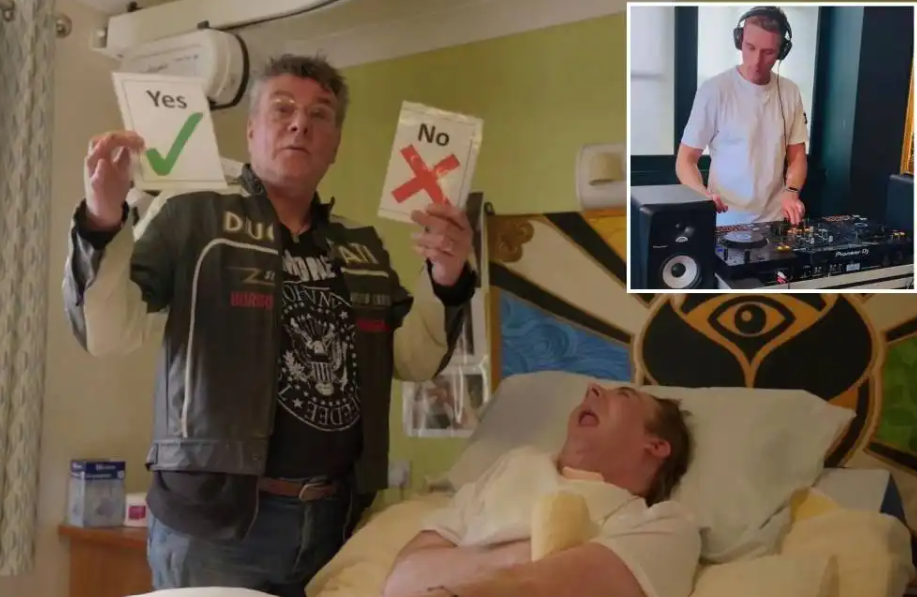
A 34-year-old fitness enthusiast and aspiring DJ has been left virtually paralyzed and unable to speak after a hospital allegedly dismissed warning signs of a serious brain condition as nothing more than a virus.
Oli Coppock has now been non-verbal for more than two years and requires tubes for breathing, feeding and toileting after suffering catastrophic brain stem damage.
His family has taken legal action against the hospital, which has since admitted liability and acknowledged that a CT scan should have been performed.
Coppock’s ordeal began after he went to Warrington Hospital in England suffering from severe headaches, dizziness, vomiting and fatigue.
According to his family, he was so convinced something was seriously wrong that he arrived at the emergency department carrying an overnight bag because he expected to be admitted.
But despite medical records showing that Coppock had undergone brain surgery and radiation treatment months earlier, his father says a doctor failed to order a CT scan.
Instead, Coppock was reportedly told he had a virus and was sent home with instructions to take paracetamol, the British equivalent of acetaminophen.
A later CT scan performed at another hospital revealed that Coppock had hydrocephalus, a dangerous buildup of fluid around the brain.
His father, Stephen Coppock, said the condition could have been treated if it had been caught earlier.
Instead, Oli later suffered a cardiac and respiratory arrest and sustained severe, inoperable damage to his brain stem.
He now has virtually no meaningful movement and can communicate with his family only by blinking “yes” or “no” in response to cards.
His father believes Oli remains mentally aware of everything happening around him.
“His mind is still completely active and he knows exactly what is going on, but his body can’t respond,” Stephen said.
Before the medical crisis, Oli was extremely active.
He regularly went to the gym, enjoyed long walks in England’s Lake District, loved traveling to Ibiza and attending music festivals, and had landed a weekly DJ residency near his home in Warrington.
He was also a devoted Manchester United fan.
Oli’s medical history had already been complicated.
In May 2023, a routine scan connected to an ongoing multiple sclerosis diagnosis discovered a small benign growth near his brain stem.
He underwent successful surgery in November 2023, followed by preventative proton beam therapy in Manchester the following year.
His family said he recovered well and had returned to normal life.
But everything changed after his emergency room visit in May 2024.
Stephen said his son waited nearly four hours before being triaged and that the seriousness of his symptoms was not recognized.
“It was obvious something was seriously wrong and it wasn’t just a virus,” he said.
Stephen said a simple CT scan would have revealed the fluid buildup and potentially allowed doctors to drain it before Oli deteriorated.
An internal hospital investigation later identified a series of failures, including the decision not to order a CT scan, failure to properly consider Oli’s medical history and failure to seek advice from senior doctors.
According to the family, the hospital’s own report concluded that a scan likely would have revealed the hydrocephalus and that earlier surgery could have prevented Oli’s catastrophic deterioration.
North Cheshire and Mersey NHS Foundation Trust, which operates Warrington Hospital, has since admitted that failing to perform a CT scan amounted to a breach of duty.
The Trust also acknowledged that surgery before Oli’s deterioration likely would have prevented his respiratory arrest.
Stephen, a former child protection lawyer, said the family was devastated not only by the original mistake but by what he described as a long delay before the hospital fully accepted responsibility.
He said Oli spent nearly a year in an independent neurological rehabilitation facility without the level of specialist equipment and treatment his family believed he needed.
“He trusted them and believed them to keep him safe, and now he is stuck in a room, virtually paralyzed, with breathing tubes keeping him alive,” Stephen said.
Oli has also developed severe spasticity, leaving his muscles, limbs, head and neck stiff and difficult or impossible to move.
His body has become increasingly twisted, and he remains dependent on round-the-clock care.
His father described Oli as “a prisoner in his own body.”
“He should be enjoying meals out with his friends, long walks, seeing his brother play football, going to the gym, DJing and holidays in Ibiza,” Stephen said.
“Instead, he is stuck in a bed staring at the ceiling and can only talk to his family by blinking.”
The family has now secured an interim financial payment following court approval, which is expected to help fund specialist treatment, rehabilitation and equipment.
Stephen fears the assistance may have come too late to reverse much of the damage.
He said doctors have also placed a do-not-resuscitate order and a no-ICU plan on his son despite objections from the family.
The family’s attorney, Tanzeela Aslam of Express Solicitors, said the case shows how preventable medical mistakes can permanently change a patient’s life.
She also criticized the delays in admitting liability, arguing that Oli lost valuable time when funding could have been used for therapies and treatment.
North Cheshire and Mersey NHS Foundation Trust has apologized.
“We are deeply sorry that Mr. Coppock did not receive the standard of care that should be expected,” the Trust said, adding that it recognizes the lasting impact medical harm can have on patients and their families.
For Oli’s family, however, the consequences are already devastating.
Stephen said his son had “everything to live for” before the medical crisis and now faces a life almost entirely confined to a bed.
“They robbed him of his life,” he said.