

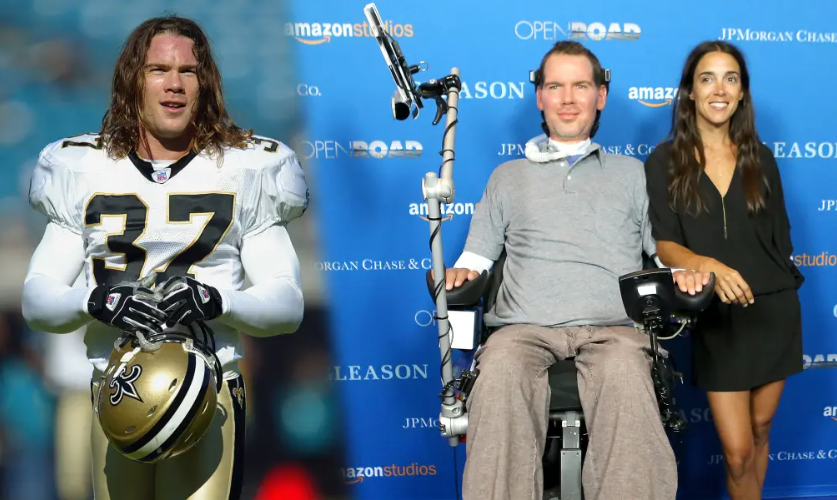
Steve Gleason is marking the 20th anniversary of one of the most unforgettable moments in New Orleans Saints history with an emotional reflection on his 15-year battle with ALS — and why he believes that single football play helped save his life.
The former Saints safety became forever linked to New Orleans on Sept. 25, 2006, when he blocked an Atlanta Falcons punt during the Saints’ first game back inside the Superdome after Hurricane Katrina.
The blocked punt was recovered in the end zone for the Saints’ first touchdown of the night, igniting the packed stadium and helping fuel a 23-3 victory.
For a city still recovering from catastrophic devastation, the moment quickly became about far more than football.
Twenty years later, Gleason says that play continues to shape his life.
Speaking on the anniversary, he reflected on his wife, children, friends, caregivers and the city that has stood behind him throughout his battle with amyotrophic lateral sclerosis.
“For me, it’s a reminder that I’m still here with them. Still a father. Still loving and being loved,” Gleason said.
Then he made a striking admission.
“I say this in my book, that if I didn’t block that punt, I’d be dead.”
Gleason explained that the play connected him to New Orleans in a way he never could have anticipated.
When ALS later changed his life, he said the same community rallied around him.
“That moment connected my life to New Orleans in a way that I never could have planned,” he said. “When the ALS came, this community showed up for us.”
Two decades after the play, Gleason said he remains grateful simply to still be here.
“20 years later, I feel that love. I’m grateful to be here for whatever comes next.”
WATCH THE VIDEO BELOW:
The blocked punt has since become known simply as “Rebirth.”
A statue outside the Superdome immortalizes the moment, with Gleason diving through the Falcons’ protection to block the kick.
Former teammates still describe it as one of those rare plays whose significance only grew with time.
Saints cornerback Curtis Deloatch recovered the blocked punt for the touchdown, but even players on the field that night have said Gleason’s play came to symbolize New Orleans fighting its way back after Hurricane Katrina.
The anniversary carries another deeply personal connection for Gleason.
Exactly five years after that historic game, he publicly announced that he had been diagnosed with ALS, a progressive neurodegenerative disease that attacks nerve cells responsible for controlling voluntary muscles.
Gleason had played his final NFL snap four years before receiving the diagnosis.
The disease has gradually taken away his ability to walk and speak on his own, but it has never stopped him from becoming one of the country’s most recognizable advocates for people living with ALS.
Through Team Gleason, he and his supporters have helped people with ALS gain access to technology, equipment and other resources designed to give them greater independence.
His advocacy ultimately earned him the Congressional Gold Medal, one of the nation’s highest civilian honors.
Gleason has also maintained the humor and defiance that have become part of his public identity.
Earlier this summer, he participated in another ALS Ice Bucket Challenge alongside author Brian Jeansonne, who also lives with ALS.
The pair joked that they were taking part while naked beneath towels before buckets of icy water were dumped over their heads.
The stunt was lighthearted, but the cause behind it remains deeply serious.
Gleason’s latest comments also came just days after former Tennessee Titans star Chris Johnson publicly discussed his own battle with ALS.
Johnson, who was diagnosed in 2025, described the painful experience of remaining mentally sharp while losing physical independence.
He now communicates using an eye-controlled speech-generating device.
For Gleason, however, this anniversary belongs to one moment.
On a September night in 2006, he burst through the Falcons’ line, blocked a punt and sent the Superdome into an eruption that ESPN’s Chris Berman later remembered as one of the loudest crowd reactions he had ever experienced.
Nobody inside the stadium could have known what the next 20 years would bring.