

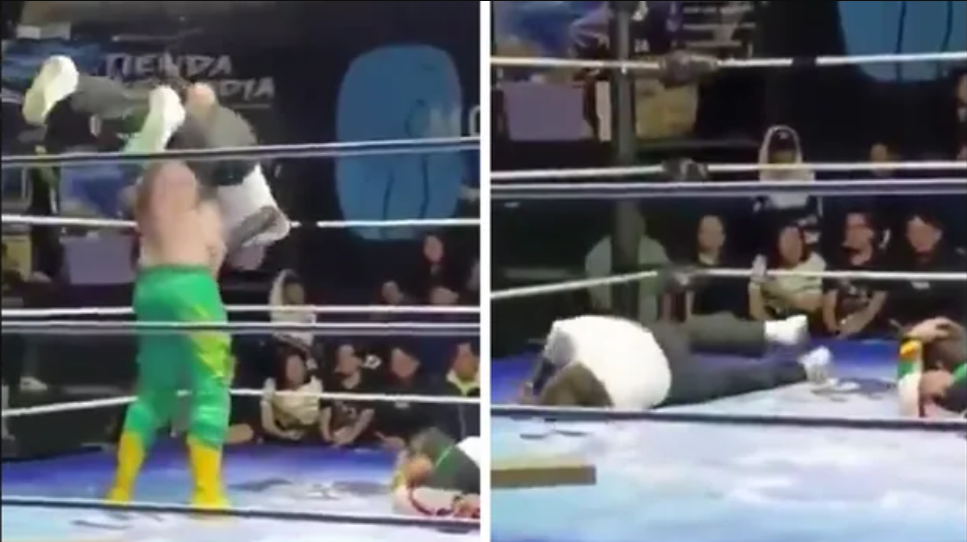
A professional wrestling match in Mexico turned into a horrifying tragedy when a 75-year-old referee died after reportedly being struck with a dangerous wrestling maneuver, leading to the arrest of a wrestler on suspicion of manslaughter.
The shocking incident unfolded during a lucha libre event in Hidalgo, Mexico, where veteran referee Gerardo Germán Pineda, better known to wrestling fans as “El Búho,” suffered fatal injuries during a confrontation inside the ring.
Authorities arrested 36-year-old professional wrestler Hijo de Fishman after the referee collapsed and never regained consciousness.
The wrestler was initially accused of culpable homicide, the Mexican legal equivalent of involuntary manslaughter. However, the case took an unexpected turn Friday, October 9, when he was released following a compensation agreement with the referee’s family.
The deadly encounter occurred during a wrestling event organized by El Patrón Espectáculos Lucha Libre in Mineral de la Reforma, a municipality in the central Mexican state of Hidalgo.
Hijo de Fishman was competing against another wrestler, Máscara Sagrada, when the referee became involved in a physical exchange that reportedly formed part of the planned entertainment.
Video footage circulating online shows the masked wrestler lifting Pineda and slamming him onto the mat.
The elderly referee can be seen moving afterward, apparently experiencing pain from the impact.
However, the most serious incident reportedly occurred later, when Hijo de Fishman allegedly performed a piledriver on Pineda.
The move, known in Mexican wrestling as a “martinete,” involves positioning a person’s head downward before dropping toward the mat. If performed incorrectly, it can place enormous pressure on the head, neck and spine.
Because of the risk of catastrophic injury, variations of the piledriver have been prohibited or restricted by numerous wrestling organizations.
According to reports from the event, Pineda remained motionless after the maneuver.
But in a disturbing twist, some spectators reportedly believed the referee was simply acting as part of the show.
Professional wrestling frequently features scripted confrontations, exaggerated reactions and staged injuries, making it difficult for spectators to immediately distinguish a planned performance from a genuine emergency.
Witness accounts suggest that several minutes passed before those present realized something was seriously wrong.
When emergency responders eventually arrived, Pineda had no vital signs and was pronounced dead.
Although footage of an earlier body slam has circulated widely, the reported fatal piledriver has not been independently verified through publicly authenticated video.
The referee’s exact medical cause of death has also not been publicly established.
The tragedy immediately raised serious questions about safety precautions at the event.
Local wrestling reports indicated that no ambulance or medical personnel were stationed at the venue when the incident occurred.
Such precautions are reportedly required for wrestling events in Hidalgo, particularly because participants face the risk of serious injuries during physical performances.
Authorities subsequently investigated the circumstances surrounding the referee’s death, including the dangerous maneuver and the event’s safety arrangements.
Hijo de Fishman was detained on October 7 and placed in the custody of prosecutors as investigators examined whether his actions constituted criminal negligence.
The wrestling promotion issued a statement expressing its sorrow over Pineda’s death while confirming that legal assistance was being provided to the accused wrestler.
The organization also said its representatives were communicating with the referee’s family.
“We deeply regret the loss of a life and express our solidarity with his family, friends and colleagues in the wrestling business,” the company said.
Promoters urged the public to avoid spreading unverified claims while authorities reviewed the circumstances.
Pineda was a familiar figure in Mexico’s professional wrestling community, having spent decades working in the sport.
Before becoming a referee, he performed as a wrestler under the name El Búho Negro II.
He later transitioned into officiating, becoming known to fans and wrestlers as El Búho, meaning “The Owl.”
Reports indicate that his wrestling career stretched back more than four decades, including nearly 30 years as a referee.
His death at 75 has devastated members of the Mexican wrestling community and renewed concerns about the risks associated with dangerous moves, particularly when older performers are involved.
In professional wrestling, referees sometimes participate in choreographed confrontations to heighten the drama. However, even carefully planned physical exchanges can result in serious injuries when timing, positioning or execution goes wrong.
The dangers are especially significant with maneuvers involving the head and neck.
While wrestling outcomes are generally predetermined, the physical contact and potential for injury are very real.
The circumstances surrounding Pineda’s death also prompted questions about whether event organizers had adequate emergency medical procedures in place.
The criminal investigation took an unexpected turn when Hijo de Fishman’s legal representatives announced that an agreement had been reached with the referee’s family.
On Friday, October 9, the wrestler was released from custody after the parties reached what Mexican law describes as a reparatory agreement.
Such agreements can allow certain criminal proceedings, including cases involving negligent homicide, to be resolved through compensation and other negotiated obligations.
The wrestler’s legal team said the agreement brought the criminal proceedings against him to an end.
Mexican media reported that the financial settlement involved approximately 600,000 Mexican pesos, although the complete terms and precise judicial documentation have not been publicly disclosed.
The agreement does not change the fact that Pineda lost his life during the wrestling event, nor does it establish that the wrestler intentionally caused his death.
No criminal conviction has been reported.
For Pineda’s family, the tragedy marks the sudden loss of a man who spent much of his life entertaining wrestling fans.
His death has also sparked wider debate about the responsibilities of wrestling promoters, performers and event organizers when dangerous maneuvers are incorporated into live performances.
The incident serves as a painful reminder that even in an industry built around scripted entertainment, the physical risks can have irreversible consequences.