

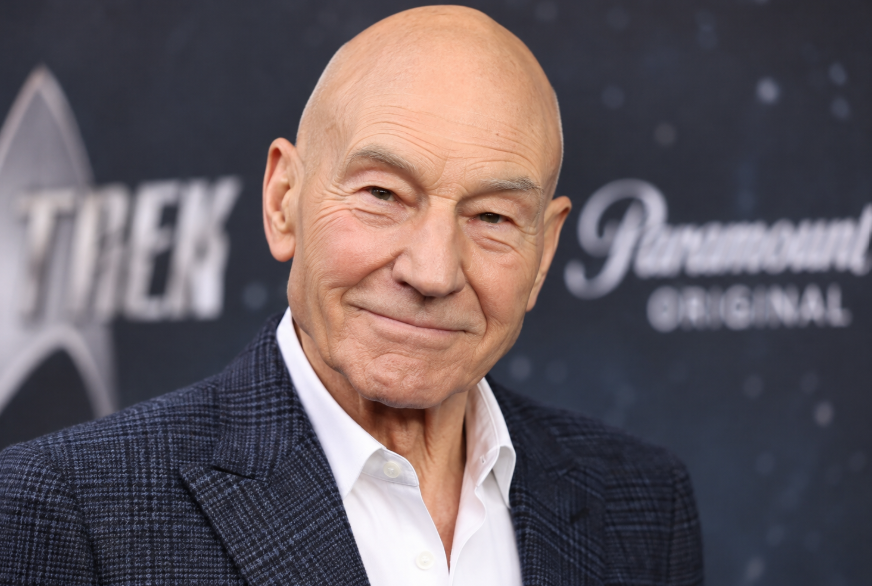
Hollywood is mourning the loss of legendary actor Patrick Stewart, whose commanding voice and unforgettable performances made him one of the most beloved stars in television and movie history. He was 86.
The British screen icon, best known for portraying Captain Jean-Luc Picard in Star Trek: The Next Generation and Professor Charles Xavier in the X-Men franchise, died Wednesday, October 28, at his Los Angeles home following a private battle with Alzheimer’s disease and Lewy body dementia.
His death was announced Thursday by his longtime spokesperson, Kelly Bush Novak, who revealed that Stewart had been quietly struggling with the two progressive neurological conditions before his passing.
The devastating announcement came as a shock to fans who had watched Stewart remain active in entertainment well into his 80s, including a celebrated return to the role of Captain Picard and an upcoming appearance in Marvel’s Avengers: Doomsday.
According to the family statement, Stewart died peacefully with his wife, singer-songwriter Sunny Ozell, by his side.
“He has been held in the warm embrace of family and friends, surrounded by live music, prayer, tears, laughter, and the kind of profound emotion that only he could inspire after a lifetime of devotion to us all,” the statement read.
The family described his final months as a “brief and poignant journey” with Alzheimer’s disease and Lewy body dementia, two conditions that can affect memory, thinking, movement and everyday functioning.
Stewart had not publicly disclosed either diagnosis, and his family has not revealed exactly when he first became ill.
For millions of Americans, Stewart will forever be remembered as the wise, dignified captain of the USS Enterprise, a role that transformed him from an accomplished Shakespearean actor into an international television superstar.
Born July 13, 1940, in Mirfield, England, Stewart grew up in a working-class family and discovered his passion for acting at an early age. His childhood was marked by financial hardship and domestic violence, experiences he later discussed openly while advocating for victims of abuse.
After studying theater, Stewart joined the prestigious Royal Shakespeare Company in the 1960s, establishing himself as one of Britain’s finest classical performers.
But his greatest breakthrough came in 1987, when he was cast as Captain Jean-Luc Picard in Star Trek: The Next Generation.
At the time, the relatively unknown British actor was an unexpected choice to lead a major American science-fiction series. Yet his commanding presence, intelligence and unmistakable voice quickly won over audiences.
The show ran for seven seasons, becoming one of the most successful installments in the Star Trek franchise and earning Stewart a devoted following that would remain loyal for decades.
He reprised the role in several feature films before returning to television in 2020 for Star Trek: Picard, which concluded its three-season run in 2023.
Stewart’s success extended far beyond the Enterprise.
In 2000, he introduced himself to a new generation of moviegoers as Professor Charles Xavier, the powerful mutant leader who founded the X-Men and believed humans and mutants could coexist peacefully.
The role became another defining chapter of his career, particularly through his memorable on-screen friendship and rivalry with Ian McKellen’s Magneto.
Their chemistry helped establish the X-Men movies as a major Hollywood franchise, while their friendship offscreen became just as cherished by fans.
Stewart continued portraying Professor X through multiple films, including the acclaimed 2017 drama Logan, and later appeared in Doctor Strange in the Multiverse of Madness.
He also filmed a return to the character for Marvel’s upcoming Avengers: Doomsday, scheduled for release in December 2026.
Despite achieving global fame, Stewart never abandoned the theater, frequently returning to Shakespeare and other demanding stage productions.
His performances earned numerous honors, including three Laurence Olivier Awards, a Grammy Award and a Tony Award nomination.
In 2010, Queen Elizabeth II knighted him for his contributions to drama, officially making him Sir Patrick Stewart.
Outside his work, the actor became known for his close friendship with McKellen, his outspoken support for survivors of domestic violence and his willingness to embrace comedy despite his reputation for playing serious characters.
He delighted audiences with appearances in Family Guy and American Dad!, proving that his legendary voice could be just as entertaining in animated comedies as it was commanding a starship.
Following the announcement of his death, tributes poured in from Hollywood colleagues and longtime friends.
Hugh Jackman, who worked alongside Stewart in the X-Men franchise, was among those remembering the actor’s extraordinary talent and kindness. McKellen and fellow Star Trek performers also joined in honoring his remarkable legacy.
The loss is particularly heartbreaking for fans because Stewart had repeatedly expressed his desire to continue acting for as long as possible.
In one of his final interviews, conducted earlier this year, he made it clear that retirement was not something he intended to embrace.
“I’ll always and forever be an actor,” Stewart declared.
Those words have taken on new meaning following his death, reflecting the passion that sustained him throughout a career spanning more than six decades.
Stewart is survived by his wife, Sunny Ozell, whom he married in 2013, and his two children, Daniel and Sophia, from his first marriage.
His family has encouraged those wishing to honor him to consider making donations to organizations supporting Alzheimer’s research and caregivers.
Although Stewart’s extraordinary journey has come to an end, his influence will continue through generations of fans who grew up watching him command the Enterprise, guide the X-Men and bring some of literature’s greatest characters to life.
For many, he was more than a Hollywood star. He represented wisdom, compassion, dignity and the belief that humanity could strive for something better.
And while millions will remember him for his iconic command to “Make it so,” Patrick Stewart’s greatest legacy may be the extraordinary life he devoted to storytelling.