

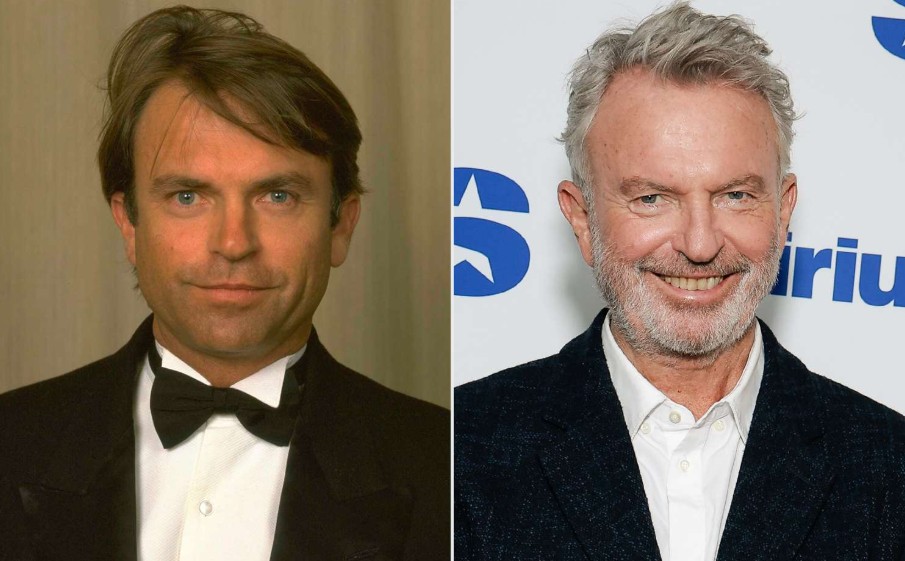
Sam Neill, the celebrated actor whose five-decade career included more than 150 film and television roles, has died at age 78.
Neill died Monday in Sydney, Australia, his family announced in a statement posted to Instagram. The family did not disclose a cause of death or specify where in Sydney he died, describing the loss as sudden and unexpected.
Although Neill had been diagnosed with angioimmunoblastic T-cell lymphoma in March 2022, his family said he remained cancer-free at the time of his death.
Best known to millions of moviegoers as paleontologist Dr. Alan Grant in Jurassic Park, Neill built a remarkably varied career that stretched far beyond the blockbuster dinosaur franchise.
The ruggedly handsome New Zealand star possessed the magnetism of a traditional leading man but consistently embraced the variety and complexity of a character actor.
Few years demonstrated that range better than 1993.
In Steven Spielberg’s Jurassic Park, Neill played the heroic and wonder-struck Dr. Grant as he fought to survive an island overrun by dinosaurs. That same year, he appeared as a heartbroken and betrayed husband in Jane Campion’s dark, mysterious drama The Piano.
Neill also memorably portrayed brooding or troubled husbands opposite Anjelica Huston in Family Pictures, Nicole Kidman in Dead Calm and Meryl Streep in A Cry in the Dark.
His cool and seductive performance as real-life British spy Sidney Reilly in the 1983 television series Reilly, Ace of Spies helped establish him internationally and eventually placed him among the actors considered to become the next James Bond.
Critics frequently praised Neill for bringing depth and nuance even to projects that received less attention. The New York Times once highlighted his “cryptic brusqueness” in the television series Alcatraz and his “avuncular suavity tinged with a dignified sadness” in the 2000 film The Dish.
One of Neill’s most important early mentors was acclaimed English actor James Mason.
Neill once explained that Mason had a rare ability to reveal unexpected layers within a character.
“He brought a sense of complexity to parts,” Neill told Entertainment Weekly in 1993. “He was prepared to show the darker sides of light characters and vice versa.”
It was a description that could just as easily have applied to Neill’s own work.
Nigel John Dermot Neill was born on Sept. 14, 1947, in Omagh, County Tyrone, Northern Ireland. His mother, Priscilla Ingham Neill, gave birth to him on the family’s kitchen table.
His father, Dermot Neill, was a New Zealander serving as an officer in the British Army. Sam was the second of the couple’s three children.
When he was 7, the family moved to New Zealand’s picturesque South Island.
Neill attended Cashmere Primary School before boarding at Medbury School and Christ’s College in Christchurch. Although he appeared in several school productions, he later described himself in his 2023 memoir, Did I Ever Tell You This?, as a “very ordinary student” who was “irredeemably lazy.”
His childhood was complicated by a stutter, a noticeably British accent and a first name he believed made him an easy target among his classmates.
“To land in a pretty rough playground in a New Zealand primary school with a plum in the voice and Nigel for a name was asking for trouble,” he wrote.
At age 11, he began calling himself Sam after being inspired by characters in Western movies.
Neill later called it “probably the best decision I made in my life.”
“Sam is easy to say, sounds friendly, sounds a bit blokey and has a touch of the Labrador about it,” he wrote.
He initially attended the University of Canterbury in Christchurch before transferring to Victoria University of Wellington. He graduated in 1970 with a bachelor’s degree in English literature.
“Acting was about the only thing that I was good at in school,” he once told the Chicago Tribune.
Neill began his professional career onstage with Wellington’s Downstage Theatre, earning 35 New Zealand dollars a week along with a nightly plate of lasagna.
He later traveled around the country with the New Zealand Players Drama Quartet, performing Shakespeare and other classics for schoolchildren.
In search of steadier work, Neill joined New Zealand’s National Film Unit, a government-owned production company where he directed a series of documentary shorts.
He also appeared in the 1975 short film Ashes before landing the leading role in the 1977 political thriller Sleeping Dogs. The movie became the highest-grossing New Zealand film of its time and helped launch Neill’s international career.
While promoting Sleeping Dogs in Australia, Neill was cast in director Gillian Armstrong’s 1979 period drama My Brilliant Career.
He played the charming frontier love interest of Judy Davis’ fiercely independent lead character and reportedly earned roughly three times his salary at the National Film Unit.
Film critic Carrie Rickey later recalled being struck by the way Armstrong’s camera presented Neill as the object of desire.
“I found Neill particularly attractive, and he is lovingly and lingeringly shot in this film,” Rickey wrote in a 2019 essay for the Criterion Collection. “In other words, like the girl in most movies.”
My Brilliant Career became the first of many Australian productions for Neill. He quickly found an agent, left his position in New Zealand and relocated to Sydney.
His performance also caught the attention of James Mason, who invited Neill to stay with him and his wife in Europe.
“I like what you do,” Neill later recalled Mason telling him. “I’m sending you a plane ticket. You can stay with me and my wife and work over in this part of the world.”
Neill moved to London and remained there for the next seven years.
He made his Hollywood debut as the Antichrist in the 1981 horror film Omen III: The Final Conflict.
That same year, he appeared opposite Isabelle Adjani in director Andrzej Żuławski’s surreal and notoriously intense horror drama Possession. Neill played a husband whose wife asks for a divorce before descending into increasingly disturbing behavior.
“I call it the most extreme film I’ve ever made, in every possible respect,” Neill said during a 2021 BBC podcast interview. “I think I only just escaped that film with my sanity barely intact.”
Neill’s later Hollywood credits included The Hunt for Red October in 1990 and the science-fiction horror film Event Horizon in 1997.
His career reached a new level in 1993 when he first appeared as Dr. Alan Grant in Jurassic Park.
He returned to the role in Jurassic Park III in 2001 and reunited with original co-stars Laura Dern and Jeff Goldblum for Jurassic World Dominion in 2022.
Neill was nominated for an Emmy Award for playing the title character in the 1998 television miniseries Merlin.
His other notable television performances included Thomas Jefferson in Sally Hemings: An American Scandal in 2000, Cardinal Wolsey in The Tudors in 2007 and the relentless Northern Irish police inspector Chester Campbell during the first two seasons of Peaky Blinders from 2013 to 2014.
In 1995, Neill returned to his documentary roots by co-directing Cinema of Unease with Judy Rymer. The film explored the history and distinctive character of New Zealand cinema.
New York Times critic Janet Maslin praised Neill’s unexpected directorial voice, calling the documentary “tart” and “perceptive.”
Despite his global fame, Neill remained deeply connected to New Zealand.
He spent much of his time in Central Otago, where he began producing wine under the Two Paddocks label in 1993.
His wines were generally well received by critics, but Neill wanted them to remain accessible rather than becoming status symbols for the wealthy.
“I’d hate to think my wine was only being drunk by property developers,” he told The Guardian in 2002.
He also pushed back against the idea that an actor could not be taken seriously as a winemaker.
“People are taking the wine seriously, as they should, and that has taken a while,” he told The Australian Financial Review in 2018. “People tend to underestimate actors. They say, ‘He is an actor, what would he know?’”
In his later years, Neill attracted another generation of fans through his charming and eccentric social media posts from the vineyard near Clyde, New Zealand.
Many of the animals living on the property were given the names of famous actors.
Over the years, his four-legged and feathered companions included a pig named Anjelica Huston, a cow named Helena Bonham Carter and a striking rooster named Michael Fassbender.
Neill was diagnosed with stage-three angioimmunoblastic T-cell lymphoma after noticing swollen glands while promoting Jurassic World Dominion.
He disclosed the diagnosis publicly in 2023 while promoting his memoir. After chemotherapy eventually stopped working, Neill underwent CAR T-cell therapy as part of an Australian clinical trial.
In April 2026, he announced that scans showed no cancer in his body and advocated for wider access to the treatment for patients in Australia and New Zealand.
Neill is survived by his brother, Michael, a Shakespeare scholar and actor, and his sister, Juliet, a teacher and bookseller.
He is also survived by four children.
His son Andrew was born during the late 1960s and placed for adoption before father and son reconnected in the 1990s.
Neill had another son, Tim, during his first marriage to actress Lisa Harrow. Their marriage ended in divorce in 1989.
He later had two daughters, Maiko and Elena, during his marriage to makeup artist Noriko Watanabe. The couple separated in 2017.
Neill also leaves behind eight grandchildren.
An international celebrity and one of New Zealand’s most recognizable figures, Neill nevertheless acknowledged that part of him remained the shy and insecure little boy who had arrived from Northern Ireland decades earlier.
“My exterior is undoubtedly Sam the New Zealander,” he wrote in his memoir. “You might even recognize him.”
“But inside, somewhere very deep, there lives a small shy boy who sounds very different, and his name is not Sam. It is Nigel.”