

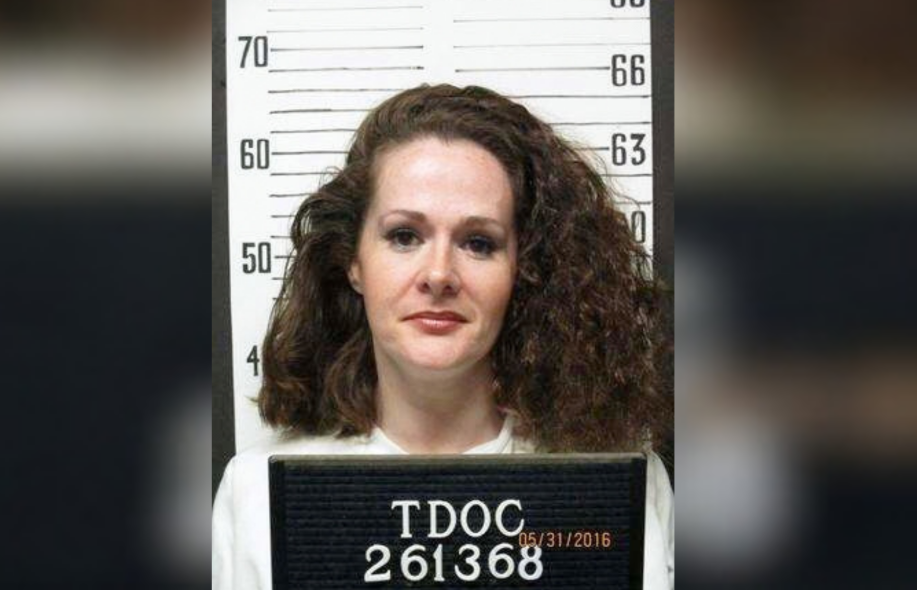
Christa Pike, the Tennessee death row inmate who survived a failed lethal injection execution, has been released from the hospital and returned to prison just 10 days after the state attempted to put her to death.
Pike, 50, was transferred back to the Debra K. Johnson Rehabilitation Center in Nashville, where she has spent approximately 30 years incarcerated for the 1995 murder of 19-year-old Colleen Slemmer.
Her attorneys confirmed the development Saturday, October 10, saying she remains under medical supervision after surviving an extraordinary execution attempt that left her hospitalized with serious complications.
“Christa Pike was discharged from a local hospital and is now at Debra K. Johnson Rehabilitation Center where she has been housed for more than 30 years,” her four attorneys said in a joint statement.
They added that Pike was grateful to the emergency responders and medical professionals who treated her and that her recovery would continue under prison medical staff.
The update marks a significant turnaround for Pike, who was rushed to a Nashville hospital on September 30 after receiving two doses of the lethal injection drug pentobarbital without dying.
The execution took place at Riverbend Maximum Security Institution, where prison officials struggled to establish intravenous access before administering the drug. Witnesses described a prolonged and visibly distressing procedure that continued even after Pike received the first dose.
When the second dose also failed to produce the expected result, officials eventually halted the execution and called for emergency medical assistance.
Pike was transported to a hospital in critical condition, where she required a ventilator and remained unconscious for several days. Her attorneys later reported serious injuries to her arms, along with complications including pneumonia and a blood clot.
Medical experts have suggested that problems with the placement of intravenous lines may have prevented the drug from entering her bloodstream as intended, although investigators have not established an official cause of the failure.
Pike eventually regained consciousness and began speaking with her attorneys, but her recovery was accompanied by confusion and considerable physical discomfort.
Her legal team described her as struggling with the emotional consequences of believing she was about to die, only to awaken in a hospital facing an uncertain future.
“Christa is dealing with the profound psychological trauma of having survived a failed execution, including the terror, pain and uncertainty of believing she was about to die,” her attorneys said in an earlier statement.
Although she is now well enough to leave the hospital, the extent of any lasting injuries remains unclear.
The Tennessee Department of Correction has maintained that its execution team followed the state’s established protocol, but the unprecedented outcome has prompted intense scrutiny of how the procedure was carried out.
Governor Bill Lee ordered an independent, third-party review of the failed execution and postponed the state’s remaining scheduled execution for 2026.
The controversy also led to the resignation of Tennessee Department of Correction Commissioner Frank Strada, whose departure was announced shortly after the incident.
Meanwhile, a judge ordered state officials to preserve evidence from the execution, including materials associated with the administration of pentobarbital, as Pike’s attorneys pursue legal challenges.
According to the Death Penalty Information Center, Pike is the first person known to have survived an execution after lethal injection drugs were administered.
Her case is especially unusual because surviving an execution attempt does not automatically overturn a death sentence. Under Tennessee law, a sentence can remain in effect if an execution is unsuccessful, potentially leaving the state able to pursue another attempt.
That possibility has become a central concern for Pike’s attorneys, who are urging Governor Lee to commute her death sentence to life in prison without the possibility of parole.
They argue that forcing Pike to undergo another execution after the physical and psychological consequences of the first attempt would raise serious constitutional questions.
However, no decision has been announced regarding whether Tennessee will seek to execute her again.
Pike was sentenced to death in 1996 for the murder of Slemmer, a fellow student at the Knoxville Job Corps Center. The killing occurred in January 1995, when Pike was 18 years old.
Prosecutors established that Pike and her then-boyfriend, Tadaryl Shipp, who was 17, attacked Slemmer after Pike became convinced the young woman was interested in Shipp.
Slemmer was beaten and stabbed during the assault, and her body was discovered in a wooded area near the training center.
The crime shocked Tennessee and led to Pike becoming the only woman on the state’s death row.
Shipp received a life sentence because he was a juvenile when the murder occurred. Pike was convicted of first-degree murder and sentenced to death.
More than three decades later, the failed execution has reopened difficult questions surrounding her punishment, including whether the state can legally proceed with another attempt and whether its lethal injection procedures meet constitutional standards.
For Slemmer’s family, the renewed attention also brings the painful history of the 1995 murder back into the public spotlight.
While Pike’s attorneys focus on her medical recovery and legal rights, the underlying conviction remains in place, and Slemmer’s death continues to be central to the case.
The independent investigation ordered by Governor Lee is expected to examine what went wrong during the September 30 procedure and whether changes are necessary before Tennessee resumes executions.
For now, Pike remains in state custody, continuing treatment as her attorneys monitor her condition and pursue efforts to prevent another execution attempt.
Her return to prison represents a major step in her physical recovery, but it leaves the most significant question unresolved: whether Tennessee will attempt to carry out her death sentence a second time.