

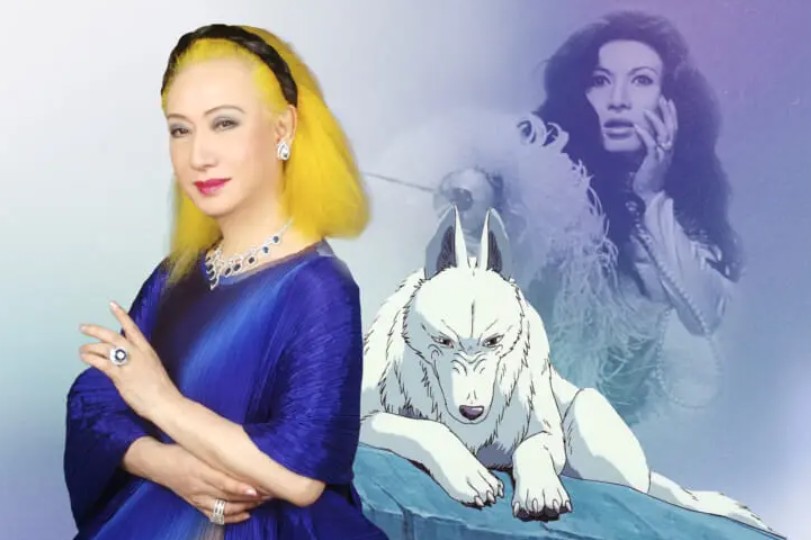
Akihiro Miwa, the legendary Japanese singer, actor and voice performer known to millions of fans through Studio Ghibli classics, has died. Miwa was 91.
Miwa’s death was announced on the entertainer’s official website, which said the beloved performer died peacefully at 9:30 a.m. on June 20 due to old age.
“It is with great sadness that we announce that Akihiro Miwa, a singer and actor affiliated with our company, passed away peacefully at 9:30 a.m. on June 20 at the age of 91 due to old age,” the statement read.
For American audiences, Miwa may be best known as the unforgettable voice behind Moro the wolf in Princess Mononoke and the Witch of the Waste in Howl’s Moving Castle. Miwa also voiced Arceus in the 2009 animated film Pokémon: Arceus and the Jewel of Life.
But in Japan, Miwa was far more than a voice actor.
Born in Nagasaki in 1935, Miwa began working in entertainment at just 16 years old and went on to become a major cultural figure as a singer-songwriter, actor and drag artist. Miwa rose to national fame with the 1957 song “Me Que Me Que” and later became widely known for the emotional ballad “Yoitomake No Uta.”
The official statement thanked fans for their decades of love and support.
“We are deeply grateful to everyone who showed him such exceptional kindness and warm support during his lifetime,” the statement continued.
According to the announcement, Miwa’s funeral was held privately in Tokyo with only close family members present, in keeping with the performer’s wishes. There are no plans for a public memorial service or gathering, and the family asked that people not send condolences or flowers.
The statement also revealed that Miwa had scaled back public appearances over the past year due to advanced age. Miwa had suffered a stroke in 2019 and had been focused on recovering strength in recent months.
About three months before Miwa’s death, the entertainer fell ill and had been recuperating at home.
In Miwa’s final moments, the statement said, the performer simply said “thank you” and quietly closed their eyes.
At the private funeral, yellow roses, Miwa’s favorite flower, decorated the altar. Letters from devoted fans were also placed in the coffin.
Miwa’s official website also shared a handwritten letter received before the performer’s death. In it, Miwa reflected on war, disasters, violence and discrimination around the world.
“Wars and disasters occur all over the world, and major disasters such as earthquakes and floods continue unabated,” the letter read. “Each time, many precious lives are senselessly taken, making this a sad world.”
The message also addressed violence, random attacks and cruelty on social media, while sharing Miwa’s hope for a more peaceful world.
“Miwa’s wish was to eliminate all discrimination and prejudice from this world and realize a society of coexistence where all people can live in peace, brightness, and joy,” the letter said.
For generations of anime fans, Miwa’s voice helped bring some of the most memorable characters in Japanese animation to life. Whether as the fierce and powerful Moro in Princess Mononoke or the mysterious Witch of the Waste in Howl’s Moving Castle, Miwa left behind a legacy that crossed music, film, television and animation.
Miwa’s death marks the loss of a true Japanese entertainment icon whose work touched fans around the world.