

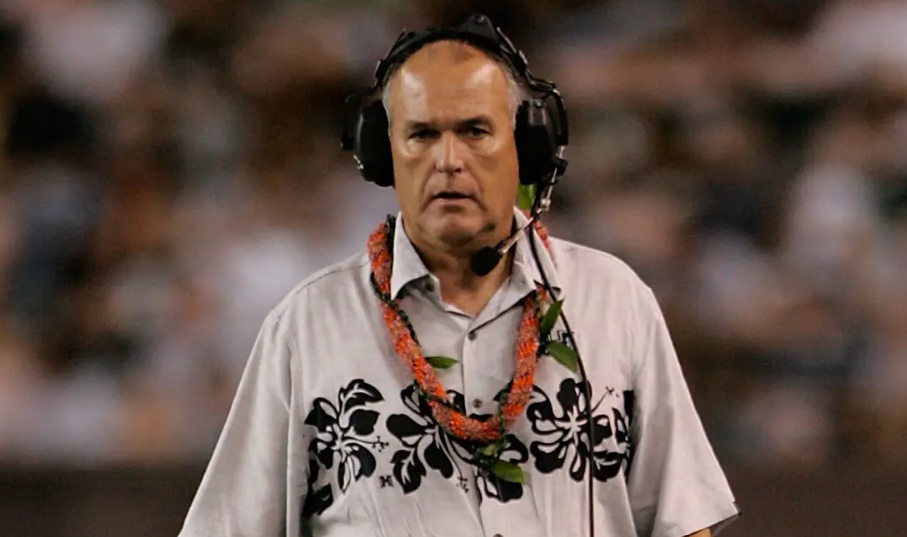
The football world is mourning the loss of June Jones, the legendary former NFL quarterback and head coach whose innovative offensive strategies helped transform the game and turn struggling college programs into national contenders. He was 73.
Jones died Thursday, October 29, in his native Oregon, according to the University of Hawaii, where he spent nine seasons as head coach and became one of the most celebrated figures in the school’s athletic history.
His death came after reports that he had been experiencing health problems and entered hospice care approximately two weeks earlier. An official cause of death has not been publicly disclosed.
The news prompted an outpouring of emotional tributes from former players, coaches and football fans who credited Jones with revolutionizing passing offenses and changing countless lives throughout a coaching career spanning more than four decades.
Jones was perhaps best known for popularizing the explosive “run-and-shoot” offense, a pass-heavy system that emphasized multiple receivers, quick decisions and unpredictable routes. The strategy helped produce record-breaking quarterbacks and some of college football’s most entertaining teams.
But long before he became a coaching legend, Jones was a quarterback himself.
After playing college football at Oregon, Hawaii and Portland State, he joined the Atlanta Falcons in 1977, spending four seasons in the NFL before transitioning into coaching.
His experience playing under offensive innovator Mouse Davis at Portland State helped shape the philosophy that would later define his career.
Jones worked his way through professional coaching positions, eventually joining the Houston Oilers in 1987, where he helped implement the run-and-shoot system with quarterback Warren Moon.
He later became offensive coordinator for the Atlanta Falcons before taking over as head coach in 1994. During his three seasons leading the team, he compiled a 19-29 record and guided Atlanta to the playoffs in 1995.
After a brief stint as interim head coach of the San Diego Chargers in 1998, Jones accepted a challenge that would forever change his legacy.
In 1999, he returned to the University of Hawaii to take over a football program that had gone winless the previous season, finishing with an embarrassing 0-12 record.
What happened next was extraordinary.
In his first season, Jones engineered one of the greatest turnarounds in college football history, leading the Rainbow Warriors to a 9-4 record and an Oahu Bowl victory.
The remarkable transformation brought national attention to Hawaii football and established Jones as one of the country’s most innovative coaches.
Over the next several seasons, his high-powered offenses produced record-setting performances and helped transform the Rainbow Warriors into a team capable of competing with some of the nation’s biggest programs.
Quarterbacks Timmy Chang and Colt Brennan became household names among college football fans, thriving in Jones’ aggressive passing system.
Chang eventually set the NCAA career passing yardage record, while Brennan became a Heisman Trophy finalist after putting together one of the most prolific seasons in college football history.
The program reached its greatest heights in 2007, when Hawaii completed an undefeated 12-0 regular season and earned a historic invitation to the Sugar Bowl.
Although the Rainbow Warriors ultimately lost 41-10 to Georgia, the season remains one of the defining achievements in Hawaii football history.
Jones finished his tenure with a 76-41 record, becoming the winningest head coach in the school’s history.
His success eventually led him to Southern Methodist University in 2008, where he inherited another struggling program and helped restore its reputation.
Under Jones, SMU reached its first bowl game in 25 years and made four consecutive postseason appearances, marking a major revival for a program that had endured decades of challenges.
He remained with the Mustangs until 2014 before continuing his coaching career in professional football, including positions in the Canadian Football League and the XFL.
Even after stepping away from major head coaching roles, Jones remained passionate about football and continued mentoring coaches interested in learning his offensive system.
Together with longtime collaborator Mouse Davis, he helped establish Run & Shoot Certification, an organization dedicated to teaching the strategy that had become synonymous with his name.
It was that organization that announced his death in an emotional social media tribute.
The group remembered Jones not simply for his impressive achievements on the field, but for the countless people he encouraged and supported throughout his life.
“June’s greatest legacy wasn’t the records, championships, or the offense,” the organization wrote, emphasizing the opportunities he created and the lives he changed.
Among those most deeply affected by his death was current Hawaii head coach Timmy Chang, who played quarterback under Jones and later benefited from his mentorship while entering the coaching profession.
Chang described Jones as a father figure and visionary who believed in him long before he became one of college football’s most accomplished passers.
“Words can’t express the sorrow I feel today,” Chang said in a statement, recalling how Jones had supported him throughout his playing and coaching careers.
He also credited Jones with putting Hawaii football on the national map and inspiring generations of young athletes to pursue opportunities they might once have considered impossible.
Hawaii Governor Josh Green joined the tributes, remembering Jones as an exceptional person whose influence extended well beyond football.
Green praised the coach for motivating young people, bringing national recognition to Hawaii and generously offering guidance to others throughout the community.
The Atlanta Falcons also honored their former head coach, recognizing his forward-thinking offensive philosophy and lasting contributions to professional football.
Across social media, coaches, broadcasters and former players shared memories of Jones’ kindness, creativity and willingness to challenge conventional thinking.
New Mexico head coach Jason Eck called him a true innovator, while football commentators remembered how his offenses helped redefine what was possible in the passing game.
For fans who watched his teams light up scoreboards during late-night Hawaii football broadcasts, Jones represented an exciting era when unconventional strategies could turn overlooked programs into national sensations.
His legacy is reflected not only in the records he set and the championships he pursued, but also in the players who became coaches, the offenses that adopted his ideas and the countless people whose lives were shaped by his mentorship.
From the sidelines of NFL stadiums to unforgettable nights at Hawaii’s Aloha Stadium, Jones spent his career proving that football could be played differently.
And although one of the sport’s great offensive minds is gone, his influence will remain part of the game for generations to come. NFL+3