

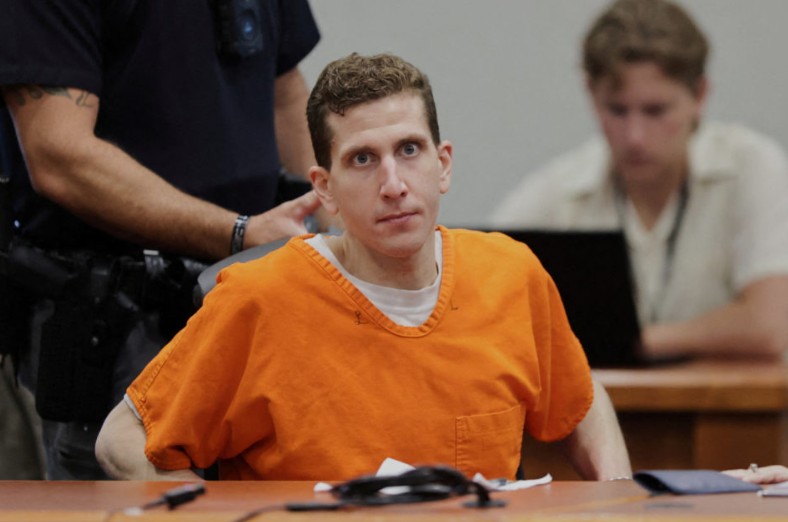
Newly unsealed court records are revealing far more about Bryan Kohberger’s mental health history, including four previously undisclosed diagnoses and detailed observations about his behavior during months of psychological testing.
Kohberger, who pleaded guilty in 2025 to murdering four University of Idaho students, had previously disclosed in a court filing that he was diagnosed with four conditions in February 2025: Autism Spectrum Disorder Level 1, obsessive-compulsive disorder, attention-deficit/hyperactivity disorder and Avoidant/Restrictive Food Intake Disorder, or ARFID.
But the filing provided few details about how those diagnoses were reached.
Now, the neuropsychological evaluation behind them has been unsealed, offering a closer look at assessments performed by defense expert Rachel Lawson Orr, PsyD, ABPP-CN.
Orr was hired by Kohberger’s defense team and met with him six times over approximately three months for interviews, testing and evaluations.
The assessment became relevant as Kohberger’s attorney, Anne Taylor, battled prosecutors over how his mental health and developmental conditions could be presented in court.
Taylor argued that Kohberger’s disabilities should potentially be considered mitigating evidence rather than something that could be used against him as an aggravating factor.
The defense made clear that the evaluation was not intended to argue Kohberger lacked the mental capacity to stand trial or understand his actions. Instead, Orr could have been called to testify if prosecutors raised certain claims regarding his mental health.
According to the newly released report, Orr observed what she described as a “restricted range of facial expression,” with Kohberger generally appearing stoic.
She noted that his smiles were often slight and that social smiling was inconsistent or sometimes absent.
Orr also described a number of behaviors she considered socially atypical, including limited gestures, unusual speech tone and cadence, awkward interactions, difficulty recognizing humor and a tendency to redirect conversations toward his own experiences.
At times, she said, Kohberger would continue jokes longer than expected or make comments that seemed unusual for the situation.
She also noted occasional intense staring and abrupt responses during cognitive testing.
In one example cited in the report, Kohberger reportedly responded firmly, “I’ll tell you when I’m done,” after being asked whether he had anything else to add during an exercise.
Orr also described Kohberger as showing impulsive tendencies during testing, including rushing through tasks and violating some of the test rules.
She characterized his overall level of insight as poor, although she noted that there were occasional moments when he acknowledged his role in certain situations after being directly challenged.
Kohberger’s parents and two sisters were also interviewed as part of the evaluation.
According to Orr, relatives described longstanding difficulties involving nonverbal communication, limited facial expressions, rigid thinking and trouble adjusting when routines changed.
Family members also said they had repeatedly tried to coach Kohberger socially and give him feedback about his interactions, but saw little improvement.
Orr ultimately diagnosed Kohberger with Autism Spectrum Disorder Level 1 without intellectual or language impairment, OCD, ADHD and ARFID.
The evaluation also revealed four additional conditions that Orr said Kohberger had met the diagnostic criteria for at some point in his life.
Those included Developmental Coordination Disorder, an unspecified depressive disorder, anorexia nervosa and Opioid Use Disorder.
The opioid disorder stemmed from Kohberger’s past heroin addiction as a teenager and was listed as being in sustained remission.
None of the diagnoses were used by Kohberger to claim he was legally incapable of understanding his guilty plea.
When he entered that plea, Kohberger acknowledged that he understood he faced four life sentences for the murders as well as an additional sentence for burglary.
On July 2, 2025, Kohberger admitted in court to killing University of Idaho students Madison Mogen, 21, Kaylee Goncalves, 21, Xana Kernodle, 20, and Ethan Chapin, 20.
Three weeks later, he was sentenced to four consecutive life terms in prison for the killings.
Then, in July 2026, Kohberger filed a motion asking the court to throw out his guilty plea and allow him to go to trial, arguing that he received ineffective assistance from his attorneys.
Prosecutors had not yet responded to that filing at the time of the report.
The newly unsealed evaluation does not change Kohberger’s conviction, but it offers the most detailed public look yet at the psychological assessments conducted as his defense team prepared for a trial that ultimately never happened.
 Liberate Bible Study