

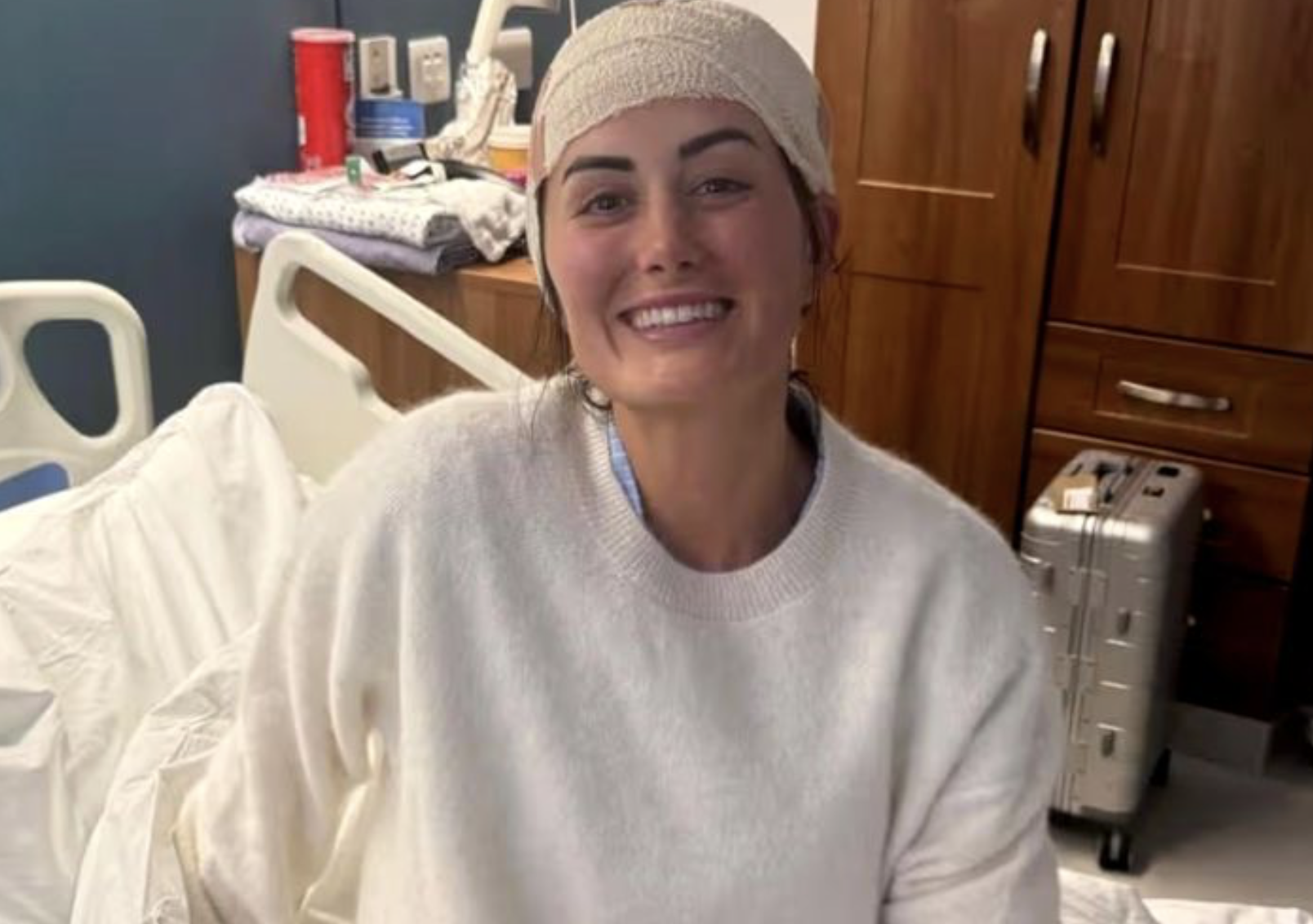
What started as a celebratory trip home from a music festival turned into something no one could have imagined.
For 29-year-old Lauren Macpherson, the moment a suitcase fell from an overhead rack on a train didn’t just leave her shaken — it changed her life forever.
Macpherson had been riding high. She had just passed an important exam for a work promotion and recently bought a home with her boyfriend, Zak. The festival she attended was meant to mark the beginning of an exciting new chapter.
Instead, it became the moment everything shifted.
While traveling back to Cardiff, a 35-pound suitcase suddenly dropped from above and struck her directly on the head. Concerned, she was taken to the hospital for a scan.
That’s when doctors saw something far more alarming than a head injury.
A shadow on her brain.
“It’s like the floor just drops from beneath you,” Macpherson said. “You don’t know what to do. It’s horrible.”
The scan led to a devastating diagnosis: a brain tumor doctors initially believed would give her 10 to 12 years to live.
Looking back, Macpherson said the diagnosis almost brought a strange sense of clarity. For months, she had been battling extreme fatigue, blackouts, and gut issues — symptoms that had been dismissed as hormonal changes or even undiagnosed ADHD.
“There is an instinct inside you,” she said. “When you’ve been feeling unwell, it just all made sense.”
At first, she wasn’t afraid. She believed doctors had caught it in time.
“I just thought, ‘They’ve found it, they can get rid of it.’”
But weeks later, everything became more serious.
Doctors warned the tumor could be glioblastoma — one of the most aggressive forms of brain cancer — and that her timeline could shrink dramatically.
“That’s when it hits you,” she said. “You’re like, ‘Oh my God… this could be two years.’”
Determined to fight, Macpherson opted for private treatment and underwent brain surgery in October 2025. Surgeons were able to remove about 80% of the tumor.
But the battle was far from over.
Further testing revealed she had a rare and incurable tumor known as a grade two oligodendroglioma. Located in her speech cortex, the tumor left her temporarily unable to speak and robbed her of much of her cognitive function.
“It was like somebody had given me a new brain,” she said. “Nothing made sense. I didn’t feel like me.”
The recovery was grueling.
“I underestimated how difficult that first month would be,” she admitted.
Now, Macpherson is facing an uncertain future. After connecting with others online, she discovered a treatment called vorasidenib — a drug that may slow the progression of her cancer. While it has been approved in parts of the U.K., it’s not currently available through public healthcare where she lives.
So she’s taking matters into her own hands.
Macpherson is pursuing the treatment privately while undergoing regular scans every three months to monitor the tumor.
Through it all, she says the emotional toll on her loved ones has been one of the hardest parts.
“I think everyone says, ‘I wish it was me, not you,’” she shared. “But you could really see it with them… the pain in their eyes.”
What was supposed to be a joyful return home turned into a life-altering diagnosis — a reminder of how quickly everything can change in a single, unexpected moment.
A fortunate accident, if it had gone totally un-diagnosed, it may have killed her sooner with nobody knowing “WHY”.
Hope she can get treatments she needs, and in time !
Good luck to you girl !